> For the complete documentation index, see [llms.txt](https://docs.aimlapi.com/llms.txt). Markdown versions of documentation pages are available by appending `.md` to page URLs; this page is available as [Markdown](https://docs.aimlapi.com/use-cases/create-a-looped-gif-for-a-web-banner.md).
# Create a Looped GIF for a Web Banner
## Idea and Step-by-Step Plan
In this use case, we create an animated banner by combining image generation, video animation, and basic editing. Here’s the plan:
1. **Generating a Reference Image**\
We are going to use one of our image models to create a picture based on a prompt (which is our business idea).
2. **Animating the Image**\
We will pass the generated image to a video model that creates a smooth, perfectly looped animation.
3. **Adjusting the Video Size**\
We will use a free online service to crop the video to the desired banner dimensions.
4. **Convert to GIF**\
We will transform the final video into a GIF format for easy integration into websites.
## Full Walkthrough
1. **Generating a Reference Image**
We chose a very fast image model [**flux/schnell**](/api-references/image-models/flux/flux-schnell.md), provided a prompt for an abstract image ("*slightly dim banner with abstract lines, base colors are coral, yellow, and magenta*"), and specified dimensions as close as possible to the sizes we needed for the website.
{% hint style="warning" %}
Unfortunately, it's not always possible to simply set the exact dimensions we need due to model limitations. For example, most image models require that both height and width values be multiples of 32.\
Video models may have minimum and maximum input size restrictions, and sometimes specific requirements for the aspect ratio as well.
{% endhint %}
Code (Python)
{% code overflow="wrap" %}
```python
import requests
def main():
response = requests.post(
"https://api.aimlapi.com/v1/images/generations",
headers={
"Authorization": "Bearer ",
"Content-Type": "application/json",
},
json={
"prompt": "slightly dim banner with abstract lines, base colors are coral, yellow and magenta",
"model": "flux/schnell",
"image_size": {
"width": 1536,
"height": 640
}
}
)
data = response.json()
print("Generation:", data)
if __name__ == "__main__":
main()
```
{% endcode %}
Model response & Generated image preview
{% code overflow="wrap" %}
```json5
Generation: {'images': [{'url': 'https://cdn.aimlapi.com/eagle/files/kangaroo/k6KvRjgHGF98TanFAf89x.png', 'width': 1536, 'height': 640, 'content_type': 'image/jpeg'}], 'timings': {'inference': 0.4465899569913745}, 'seed': 2166405766, 'has_nsfw_concepts': [False], 'prompt': 'slightly dim banner with abstract lines, base colors are coral, yellow and magenta'}
```
{% endcode %}
Image preview:
2. **Animating the Image**
Not all video models are capable of creating looped videos (where the last frame matches the first one). We chose model [kling-video/v1.6/pro/image-to-video](/api-references/video-models/kling-ai/v1.6-pro-image-to-video.md). It accepts the first and last frames separately, using the parameters `image_url` and `tail_image_url` respectively.
For the video generation prompt, we used *"slow fluid-like motion of patterns of the image."*\
Feel free to experiment with effects, as long as they match the video looping!
{% hint style="warning" %}
Don't worry: the code below is long because it automates the process of requesting the ready video from the server every 10 seconds, so you don't have to do it manually. Enter your [AIMLAPI key](https://aimlapi.com/app/keys) in the second line, and all the necessary parameters are passed in the first function, `generate_video()`.
{% endhint %}
Code (Python)
{% code overflow="wrap" %}
```python
base_url = "https://api.aimlapi.com"
api_key = ""
url = f"{base_url}/v2/generate/video/kling/generation"
# Creating and sending a video generation task to the server
def generate_video():
# Here's our image url
input_url = "https://cdn.aimlapi.com/eagle/files/kangaroo/k6KvRjgHGF98TanFAf89x.png"
payload = {
"model": "kling-video/v1.6/pro/image-to-video",
"image_url": input_url, # it will be the 1st video frame
"tail_image_url": input_url, # it will be the last video frame
"duration": 5, # Length of the generated video in seconds
"prompt": "slow fluid-like motion of patterns of the image"
}
headers = {"Authorization": f"Bearer {api_key}", "Content-Type": "application/json"}
response = requests.post(url, json=payload, headers=headers)
if response.status_code >= 400:
print(f"Error: {response.status_code} - {response.text}")
else:
response_data = response.json()
print(response_data)
return response_data
# Requesting the result of the task from the server using the generation_id
def get_video(gen_id):
url = f"{base_url}/v2/generate/video/kling/generation"
params = {
"generation_id": gen_id,
}
# Insert your AIML API Key instead of :
headers = {
"Authorization": f"Bearer {api_key}",
"Content-Type": "application/json"
}
response = requests.get(url, params=params, headers=headers)
# print("Generation:", response.json())
return response.json()
def main():
# Generate video
gen_response = generate_video()
gen_id = gen_response.get("id")
print("Gen_ID: ", gen_id)
# Try to retrieve the video from the server every 15 sec
if gen_id:
start_time = time.time()
timeout = 600
while time.time() - start_time < timeout:
response_data = get_video(gen_id)
if response_data is None:
print("Error: No response from API")
break
status = response_data.get("status")
if status in ["queued", "generating"]:
print(f"Status: {status}. Checking again in 15 seconds.")
time.sleep(15)
else:
print("Processing complete:\n", response_data)
return response_data
print("Timeout reached. Stopping.")
return None
if __name__ == "__main__":
main()
```
{% endcode %}
Model response & Generated video preview
{% code overflow="wrap" %}
```json5
{'id': '36f1c11f-e0ab-4048-9b2d-60e413ebb64c:kling-video/v1.6/pro/image-to-video', 'status': 'queued'}
Gen_ID: 36f1c11f-e0ab-4048-9b2d-60e413ebb64c:kling-video/v1.6/pro/image-to-video
Status: generating
Still waiting... Checking again in 10 seconds.
Status: generating
Still waiting... Checking again in 10 seconds.
Status: generating
Still waiting... Checking again in 10 seconds.
Status: generating
Still waiting... Checking again in 10 seconds.
Status: generating
Still waiting... Checking again in 10 seconds.
Status: generating
Still waiting... Checking again in 10 seconds.
Status: generating
Still waiting... Checking again in 10 seconds.
Status: generating
Still waiting... Checking again in 10 seconds.
Status: generating
Still waiting... Checking again in 10 seconds.
Status: generating
Still waiting... Checking again in 10 seconds.
Status: generating
Still waiting... Checking again in 10 seconds.
Status: generating
Still waiting... Checking again in 10 seconds.
Status: generating
Still waiting... Checking again in 10 seconds.
Status: generating
Still waiting... Checking again in 10 seconds.
Status: generating
Still waiting... Checking again in 10 seconds.
Status: generating
Still waiting... Checking again in 10 seconds.
Status: generating
Still waiting... Checking again in 10 seconds.
Status: generating
Still waiting... Checking again in 10 seconds.
Status: completed
Processing complete:\n {'id': '36f1c11f-e0ab-4048-9b2d-60e413ebb64c:kling-video/v1.6/pro/image-to-video', 'status': 'completed', 'video': {'url': 'https://cdn.aimlapi.com/eagle/files/zebra/pmpSUqe0n-1Z1ysnob6vF_output.mp4', 'content_type': 'video/mp4', 'file_name': 'output.mp4', 'file_size': 3643207}}
```
{% endcode %}
Very small video preview:
3. **Adjusting the Video Size**
For video cropping, we used the [free web service](https://ezgif.com/crop-video).
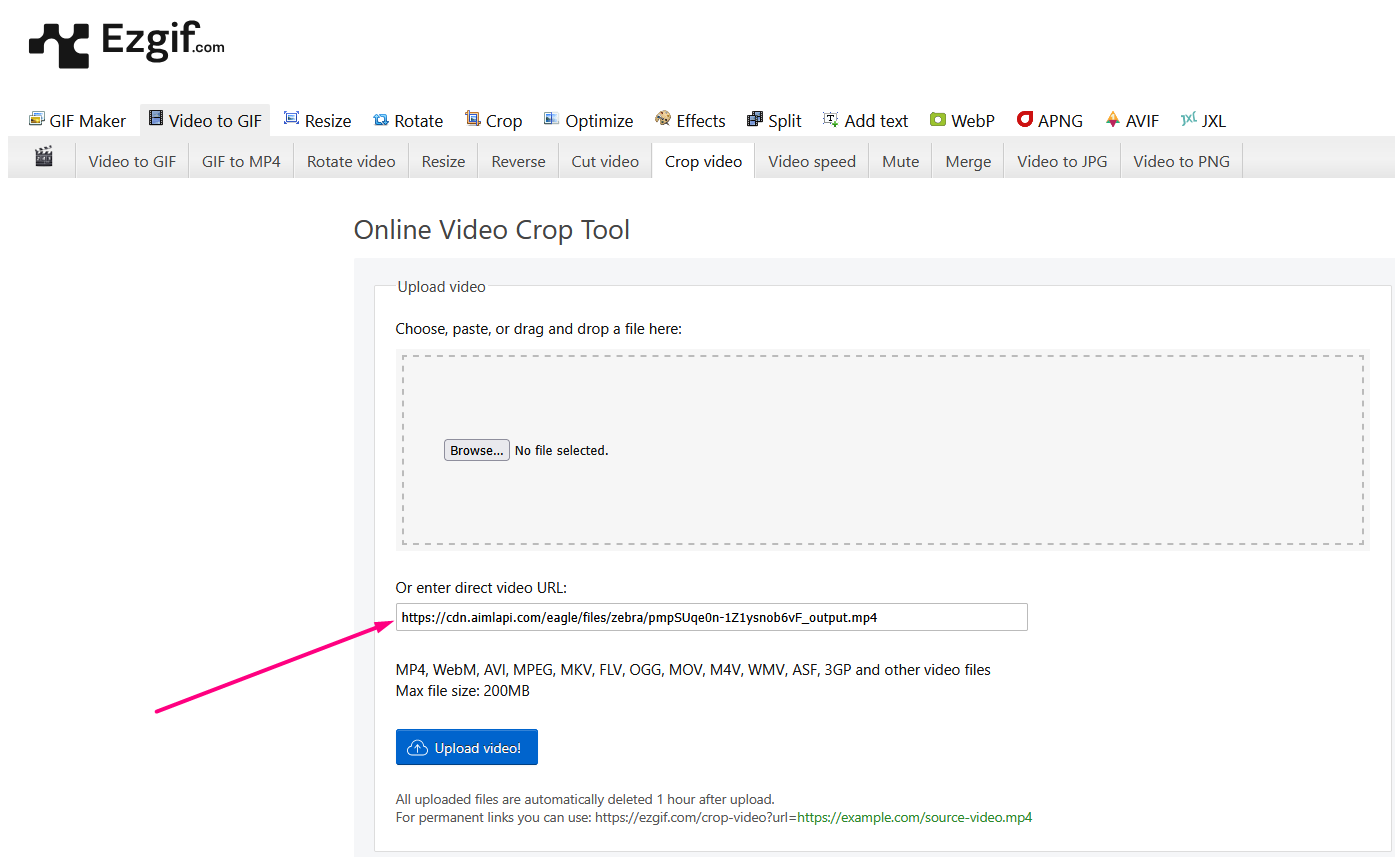
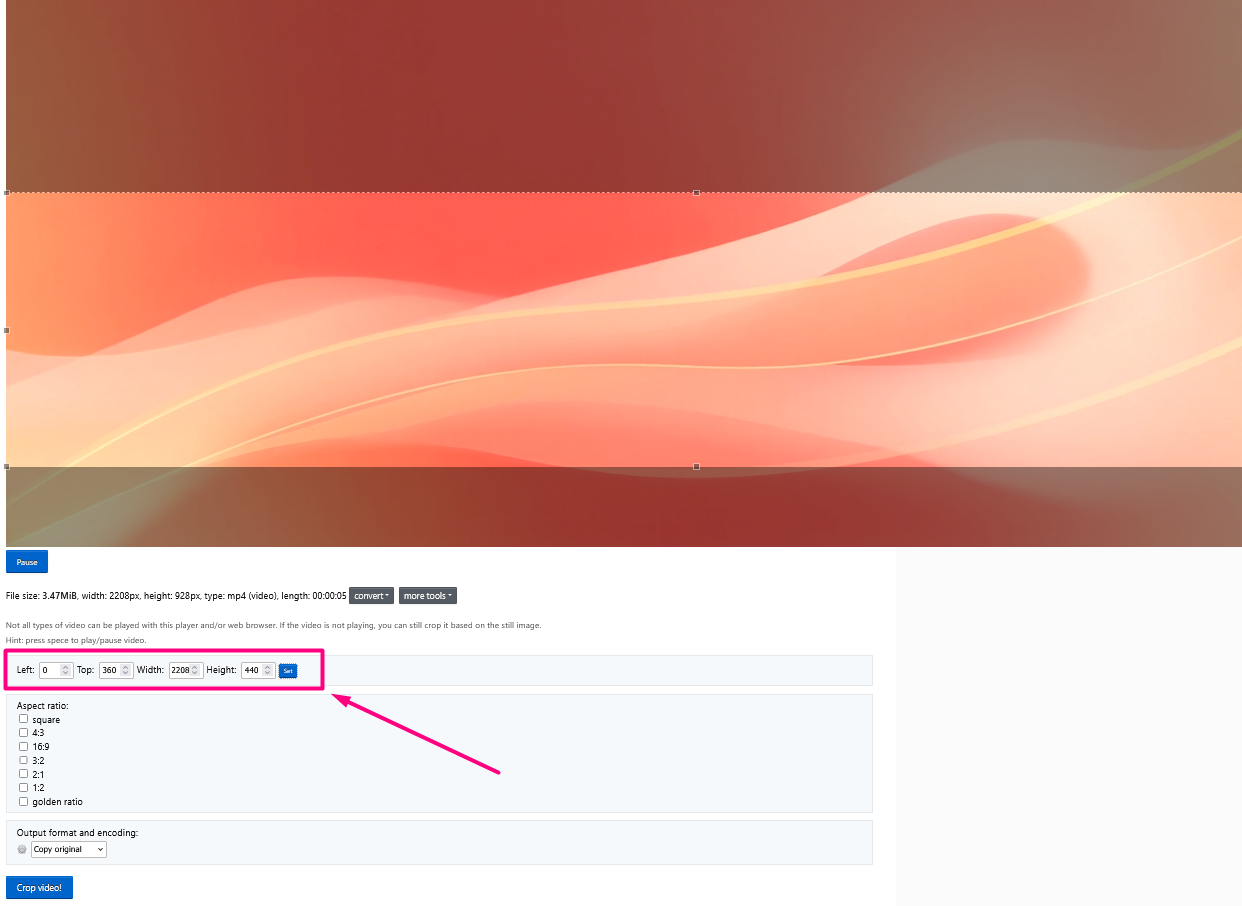
Settings
Select the **Crop video** tab and enter the URL of your video.
Using the preset aspect ratios or manual settings, adjust the area of your video that you want to turn into a GIF banner. Then click **Set**, and after that — **Crop video**.
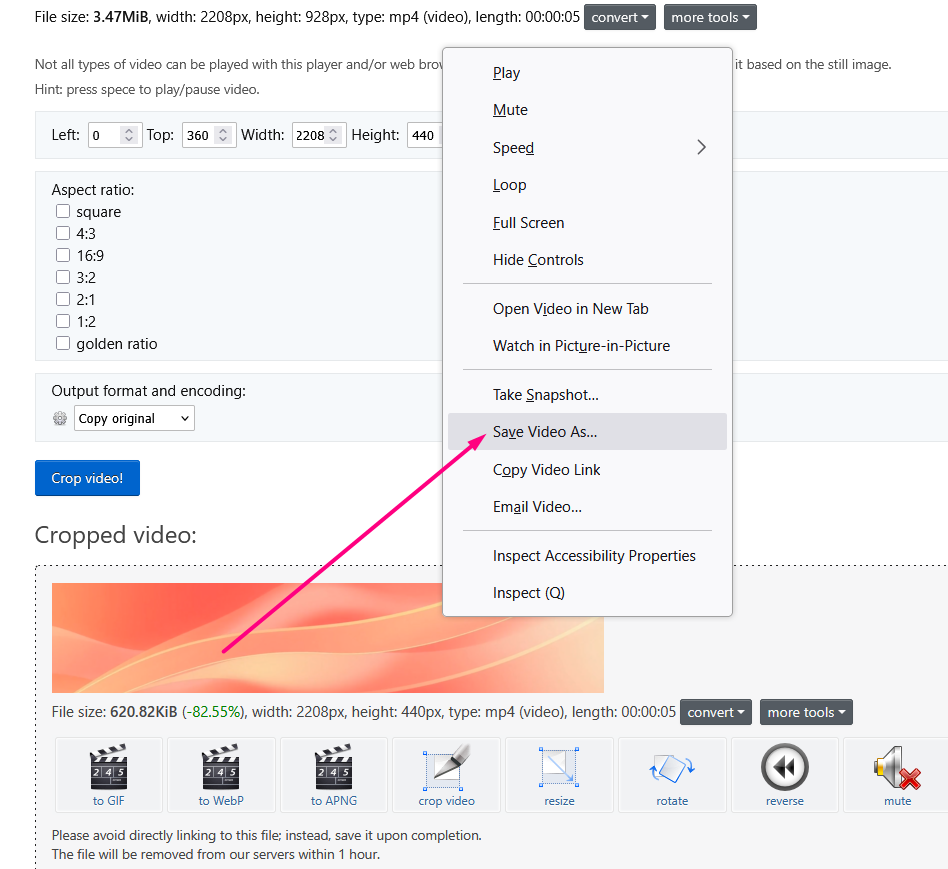
After a few seconds of processing, a window with the cropped video fragment will appear below. Right-click on it and select **Save**.
4. **Convert to GIF**
For this step, we used another [free web service](https://www.freeconvert.com/convert/video-to-gif).
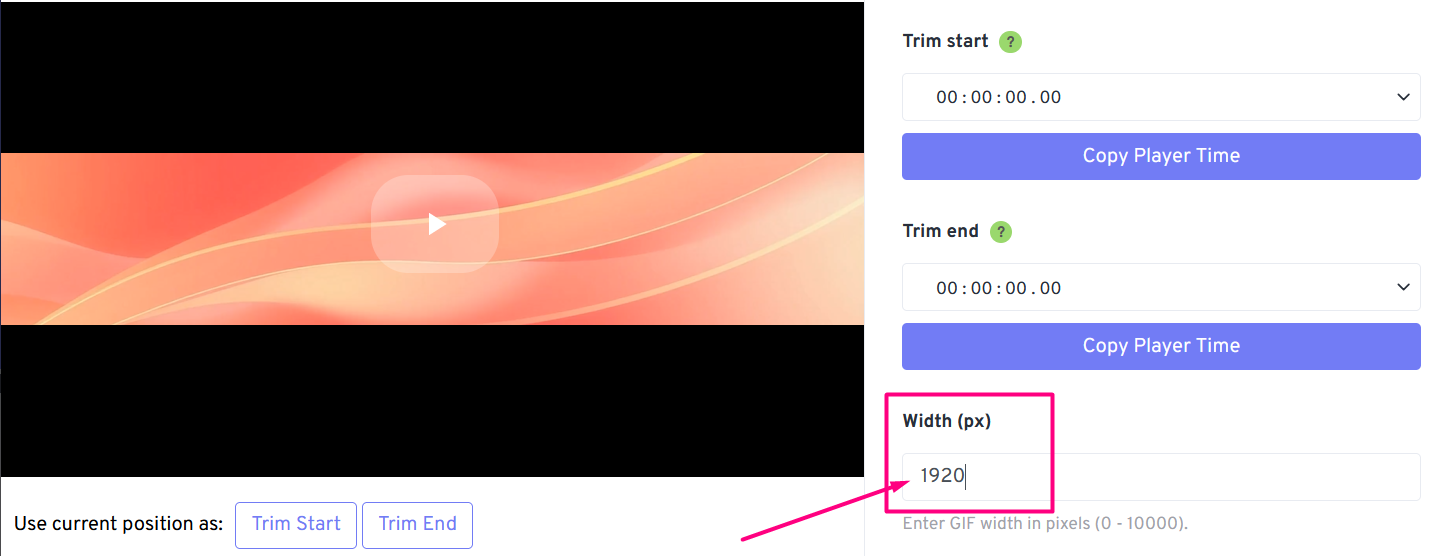
Settings
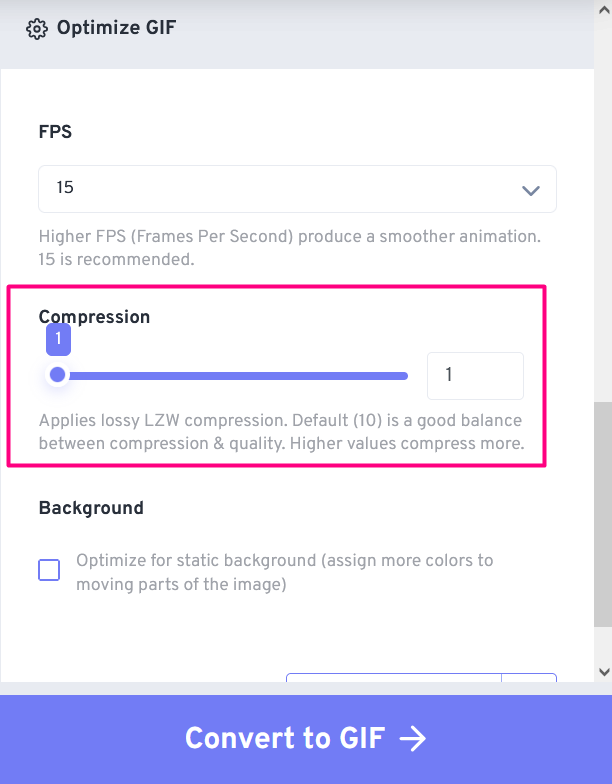
Click **Choose Files** and upload your cropped video. After that, the output GIF settings will become available. Set your desired width.
Scroll down in the settings to find the GIF compression parameter. We set it to minimum for better image quality, but for larger videos, feel free to experiment with different values.\
Then click **Convert to GIF**.
All that's left is to upload the finished GIF file. In the next section, you can see it in action.
## Results
Animated Looped Web Banner
***
You can use such banners in the website header or overlay your promotional text on a transparent background in a website builder to make it look like a single element.\
Best of luck with your implementation!
---
# Agent Instructions
This documentation is published with GitBook. GitBook is the documentation platform designed so that both humans and AI agents can read, navigate, and reason over technical content effectively. Learn more at gitbook.com.
## Querying This Documentation
If you need additional information that is not directly available in this page, you can query the documentation by asking a question.
Perform an HTTP GET request on the following URL with the `ask` and `goal` query parameters:
```
GET https://docs.aimlapi.com/use-cases/create-a-looped-gif-for-a-web-banner.md?ask=&goal=
```
`ask` is the immediate question: it should be specific, self-contained, and written in natural language.
`goal` is what the user is ultimately trying to achieve, the reason they need the answer. Sharing it helps GitBook give you a better, more relevant answer. A goal is most helpful when it describes the outcome the user wants rather than restating the question. For example, with `ask=how do I create an API token`, a goal like `automate deployments from our CI pipeline` lets GitBook tailor the answer to that use case.
The response will contain a direct answer to the question and relevant excerpts and sources from the documentation.
Use this mechanism when the answer is not explicitly present in the current page, you need clarification or additional context, or you want to retrieve related documentation sections.